About
A think tank devoted to socio-ecological transformation
A think tank is an organization that develops conceptual frameworks, analyses and proposals to inform action on collective issues.
Our mission
To strengthen collective agency and the quality of democratic debate, in order to accelerate socio-ecological transformation.
- Our vision
- A society able to act collectively on the key levers of socio-ecological transformation.
- Our conviction
- We believe in the capacity of societal actors to act, and to accelerate socio-ecological transformation.
1
What we publish
Decision-support tools in open access, with no account and no trackers.
 TypologyBetaAtlas of political stancesLocate a position in the ecological debate, including your own.
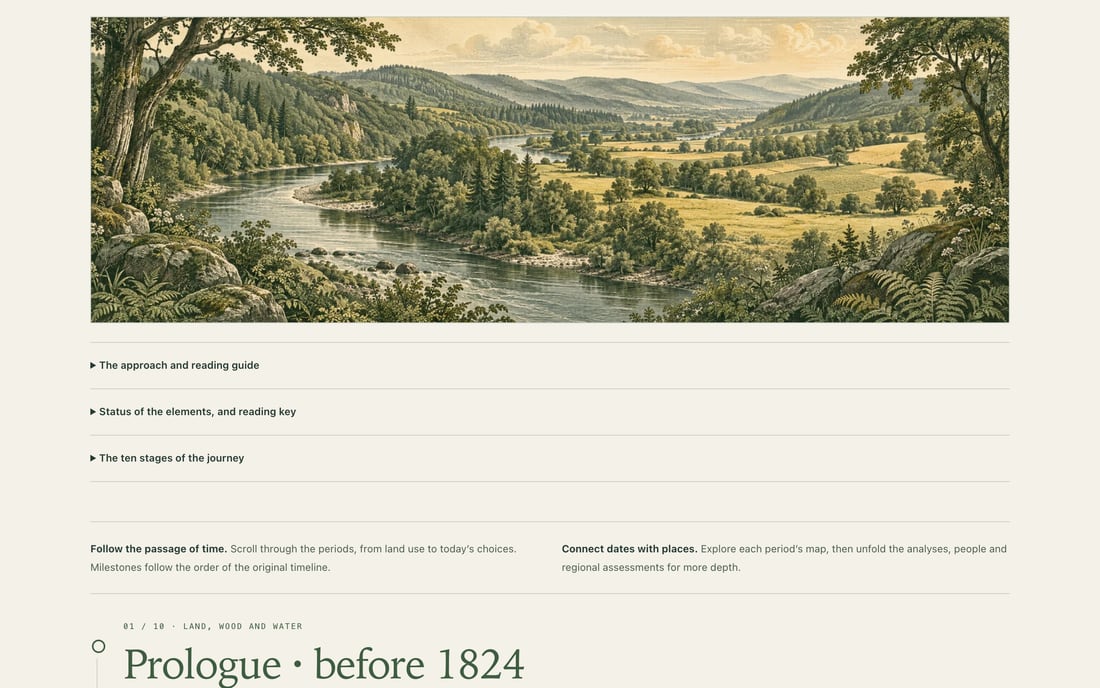 TimelineTwo centuries of ecological debateUnderstand why two centuries of knowledge did not produce two centuries of action.
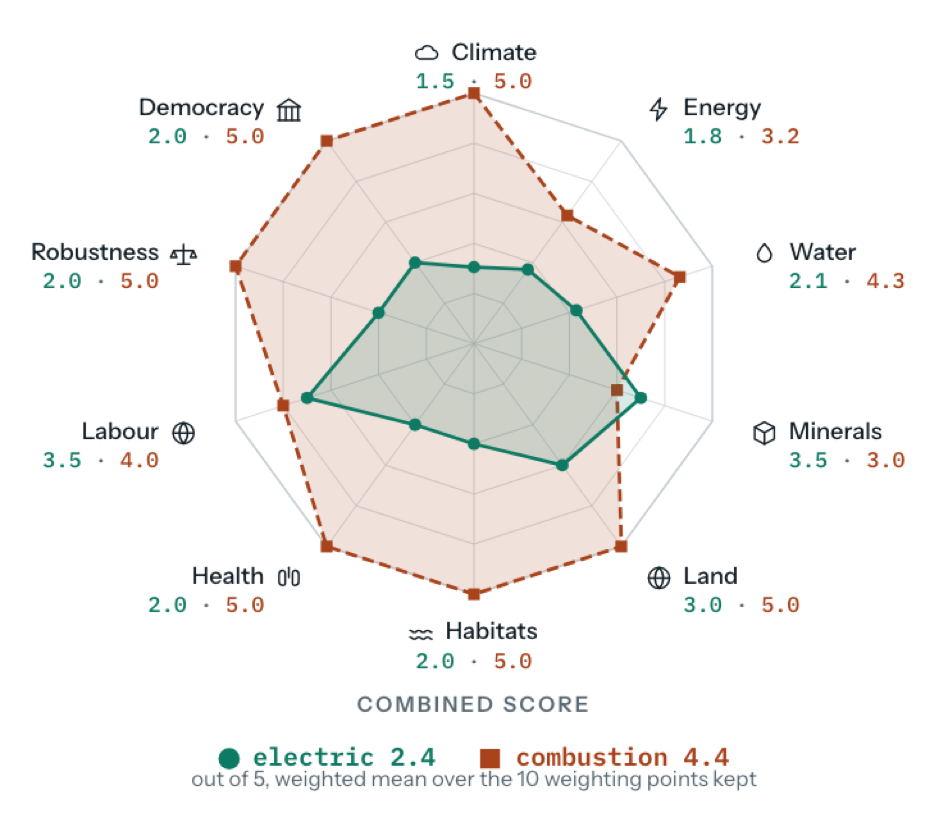 ComparisonElectric and combustion vehiclesUnderstand what really separates electric from combustion, with your own assumptions.
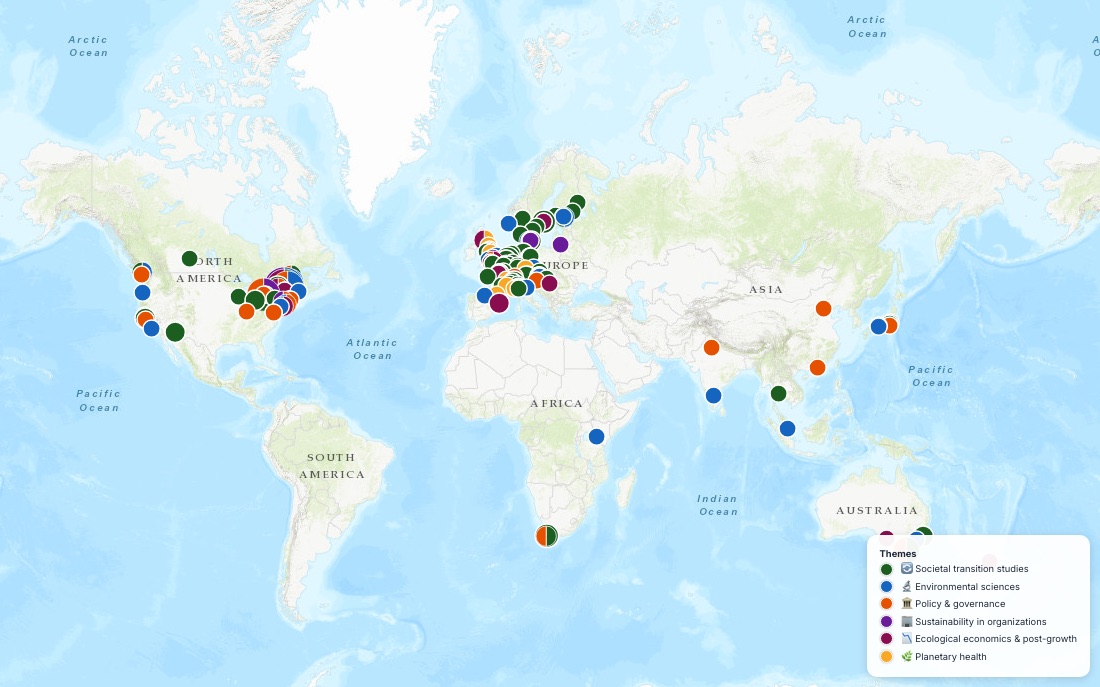 DirectoryStudy programsFind a program tied to socio-ecological transformation, from college to doctorate.
 Systems mapBetaSystems map of underlying causesTrace ecological crises back to their root causes: our worldviews, our rules, our institutions.
 Trade-offBetaQuebec Energy SimulatorTest the major choices for Quebec’s electricity supply and see their trade-offs.
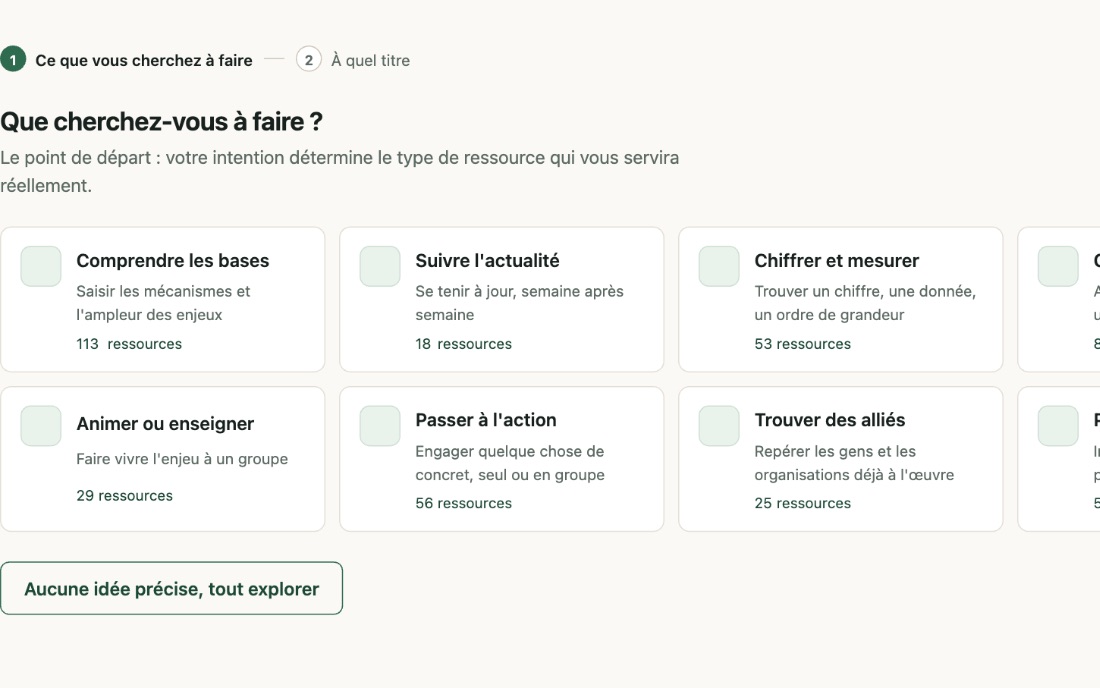 DirectoryResourcesFind the right resource according to what you are trying to do.
2
Our approach
From a systemic and transdisciplinary approach, every tool goes through the same six steps.
We make knowledge accessible to inform action, while preserving the nuances essential to understanding the issues.
Monitoring
Scientific and grey literature, initiatives around the world. Every figure we keep points to its source, checked before it is cited.
Plain language
Research turned into usable tools and analyses. Every assumption carries its value, its source and its status, and the data can be downloaded.
Frameworks
Frameworks that support concrete, considered and transformative action. Every tool states what it does not do, and its judgements are presented as judgements.
Review
Every tool is submitted to specialists in the field; their comments and the resulting adjustments are recorded in its release notes.
Beta
Automated checks block publication when they fail. The “Beta” label marks a tool still in active exchange with experts and readers; it is removed once the tool is stable enough.
Corrections
An error, a missing source, a debatable assumption? Write to us: every correction we accept is dated and described in the tool, which carries a version number and can be cited.
One example: the technical manual of the energy simulator (in French), which explains every calculation and is checked against the model at every release.
3
Who we work for
Those who have a decision to make or to inform on socio-ecological transformation, and who want to ground it in facts. Often among the first to act in their milieu, they create the conditions for others to follow.
Elected officials and policy advisers
Weigh policy optionsGround a decision in facts: scenarios with figures, adjustable assumptions, sources to check.
Civil society and engaged citizens
Know where to actUnderstand the trade-offs and where people stand when preparing a brief, speaking in public or making a personal choice.
Journalists
Inform public debateWhen covering a proposal, check the figures and ask who would pay and who would benefit. Give readers the context to judge the choices for themselves.
The diffusion of innovations, according to Everett Rogers
The sociologist Everett Rogers showed that an innovation, a practice or an idea spreads through a population in a regular order. A few innovators try it first, often at their own risk; then come the early adopters, then the early majority, the late majority and finally the laggards. Counted year after year, adoption follows an S-curve: slow at first, fast once the majority is drawn in, then levelling off.
Early adopters are the pivot. Better rooted in their milieu than innovators, they are often its opinion leaders: their example makes the innovation visible and credible to others. It is to them, and to innovators, that Pareto speaks first.
Everett M. Rogers, Diffusion of Innovations, 5th ed., New York, Free Press, 2003 (1st ed. 1962).
4
Who we are
The board of directors
Three graduates of the maîtrise sur mesure en action climatique at Université Laval.
- President
- Raphaël Baril
- Secretary
- Frédérique Brais-Chaput
- Treasurer
- Dominik Lejeune
For the beauty that exists in this world.
DistinctionProject selected for the collective climate action call of UNIC, the international student network for the climate.
Why “Pareto”?
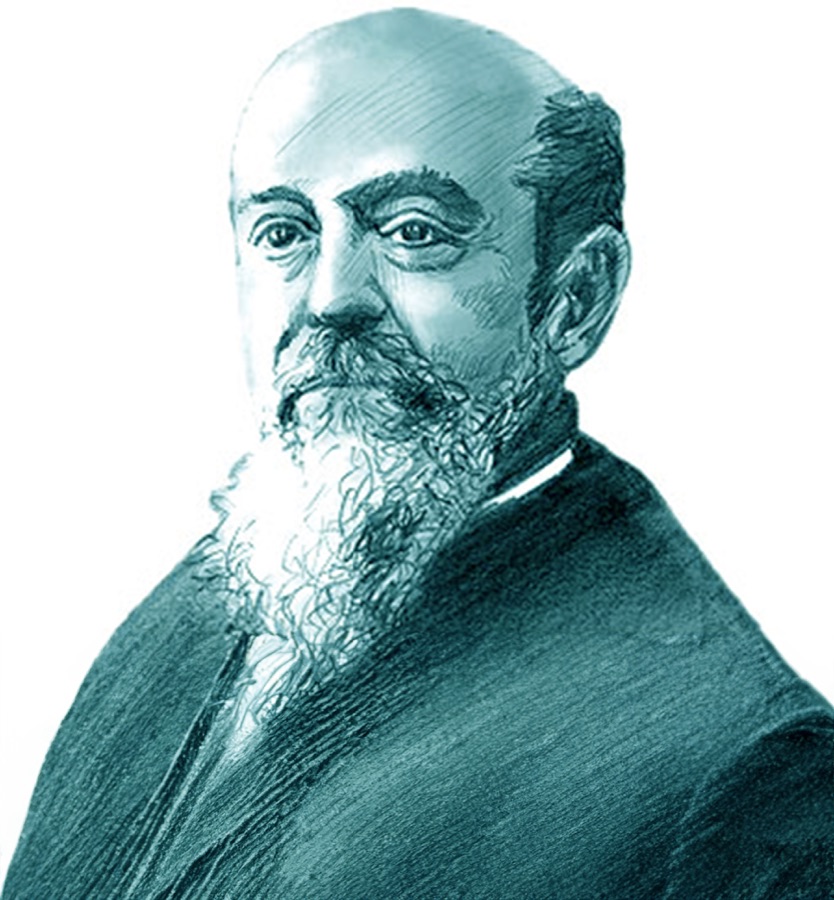
The name refers to Vilfredo Pareto (1848–1923), the sociologist and economist associated with the 80/20 principle: the idea that a minority of factors can produce a majority of effects. It also evokes an attention to the real, underlying mechanisms that shape social action.
For us, that idea calls for discernment in action: moving past scattered effort to identify the most structuring points of intervention, those from which it becomes possible to shift the dynamics as a whole.
5
Reach us
- Press requestAn interview, a figure to check, a tool to cite.
- Suggest a correctionAn error, a missing source, a debatable assumption.
- Support ParetoBecome a member or donate: Pareto runs on volunteer work.