Before climate science: local limits, collapses and the birth of the idea of sustainability
InterpretationNo society has been spontaneously ecological. What limited destruction was most often the technical power available; what sometimes regulated it were institutions, never mere virtues.
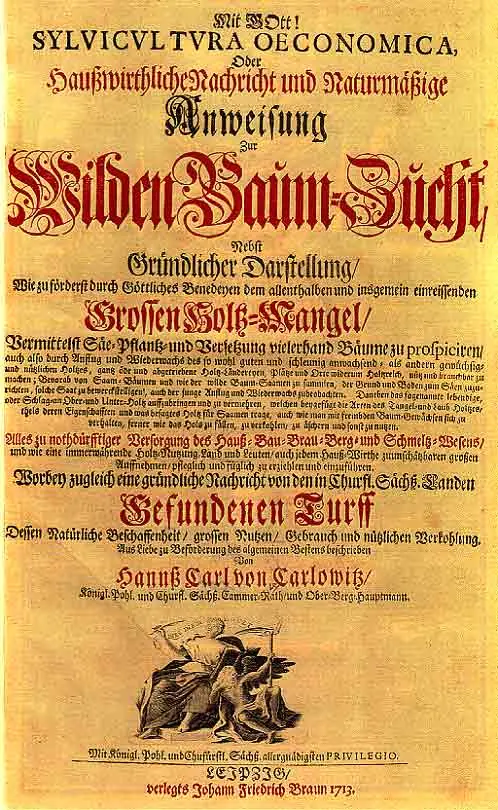
Hans Carl von Carlowitz · Wikimedia Commons · View the archive ↗
Key milestones
Before 1824: eight markers in the long view
- ~50 000 – 10 000 BCEAustralia, the Americas, Madagascar, New Zealand
Human expansion and specialized big-game hunting.
- Ecological effect
- Disappearance of most large mammals: mammoths, mastodons, giant sloths, giant beaver, moa. Climate plays a part, but human arrival coincides almost everywhere with extinction.
- What it teaches
- Very small societies, without machines or markets, were already able to wipe out entire lineages.
Intensive irrigation without sufficient drainage.
- Ecological effect
- Progressive soil salinization; wheat gives way to more tolerant barley, then yields collapse.
- What it teaches
- A technical success can destroy its own foundation within a few centuries.
Deforestation for shipping, metalworking, baths and heating; extensive grazing; silver and lead mines.
- Ecological effect
- Soil erosion and the disappearance of entire forests; lead pollution from Roman mines is measurable in Greenland ice, the first industrial signature at hemispheric scale.
- What it teaches
- An empire can lastingly degrade its material base without having any instrument to measure it.
Colonization of islands with no predators.
- Ecological effect
- Extinction of the moa within a few generations; complete transformation of island ecosystems.
- What it teaches
- The more isolated the environment, the faster and more irreversible the collapse.
Timber shortage, then reforestation policies, quotas and strict use rights.
- Ecological effect
- Effective restoration of Japan's forest cover; lasting maintenance of Alpine communal forests.
- What it teaches
- Sustainability is an institution, produced by a crisis and by an authority able to compel, not a cultural disposition.
Fumifugium and Sylva by Evelyn, Colbert's forest ordinance (1669), Sylvicultura oeconomica by Carlowitz (1713).
- Ecological effect
- Regulation of felling, planting, calculation of renewal.
- What it teaches
- The word “sustainability” is born of a military and mining supply problem, not of a concern for nature.
Fur trade for the European felt hat market; then white pine felling for the British navy.
- Ecological effect
- Collapse of beaver populations, disappearance of their dams and drying of wetlands; first massive cuts in the Ottawa valley.
- What it teaches
- The first North American resource to be exhausted was exhausted by a global market, two centuries before industrialization.
Eruption of Tambora, the most powerful of the historical era.
- Ecological effect
- “Year without a summer”: June frosts in Lower Canada and New England, lost harvests, famine and riots in Europe.
- What it teaches
- Climate is recognized as a political and social variable, eight years before Fourier states the greenhouse effect.
Explore further
What is settled, and what remains disputed
What is settled, and what remains disputed
- Debate 1🌍 Megafauna: climate or humans? Research today attributes varying shares to both factors depending on the region, with a human role all the clearer where colonization is late and the island isolated. Perspectives: systemic, living world. Status: disputed.Diffuse scope · no single location
- Debate 2🌍 The “ecocide” of Rapa Nui. The popularized account of a society that destroyed itself by cutting down its trees is contested: introduced rats, the slave trade and colonial epidemics explain much of the demographic collapse. Above all, the case illustrates how a collapse narrative can serve opposing political morals. Perspectives: systemic, discourse. Status: disputed.
- Debate 3🌍 What exactly collapses? In Goliath's Curse (2025), Luke Kemp analyses more than three hundred collapses and argues that it is not “civilizations” that fall but “Goliaths”: extended, centralized and highly unequal states, weakened by their elites' capture of resources. He adds that collapse is often partial, and that it has sometimes improved the lot of ordinary people. The thesis is debated: it is criticized for reducing multiple causation to a single factor, but it usefully shifts the question: vulnerability owes as much to the structure of power as to the environment. Perspectives: systemic, economy. Status: disputed.Diffuse scope · no single location
- Marker🌍 The limiting factor was long the power available. A stone axe, an ox-drawn plough and a sailing fleet cap the damage. Coal, then oil, lift that cap: the same willingness to extract then produces planetary effects. Perspectives: systemic, economy. Status: disputed.Diffuse scope · no single location
- Marker⚜️ Societies with a long horizon did genuinely exist. Controlled burns, seasonal fishing quotas, rules for sharing hunting territory among the nations of the Northeast: social arrangements, handed down and collectively enforced, that maintained balances for centuries, and that the fur trade disorganized within a few decades. Perspectives: living world, mobilization, law & institutions. Status: disputed.
Understanding this period: knowledge, institutions, power and discourse
Knowledge
Ecological knowledge exists, but it is local, empirical and handed down: harvest calendars, controlled burns, crop rotation, reading animal cycles. It allows fine management of a known territory, not a planetary understanding.
The first observations of degradation are ancient: Plato describes the erosion of Attica's soils, Pliny and Theophrastus link deforestation with springs running dry. These are observations, not a theory of thresholds.
Institutions
Regulations exist: hunting taboos, use rights, collectively managed commons, royal forest ordinances. They work when the resource is visible, the community stable and cheats identifiable, the conditions Elinor Ostrom would formalize three centuries later.
They fail when the resource becomes a tradable export asset, when users no longer know one another, or when a central power imposes its own calculation.
Balance of power
Agriculture produces surpluses, surpluses produce elites, and elites produce empires that draw beyond the territory they inhabit: ship timber, metals, slaves, sugar. Degradation becomes exportable, and therefore invisible to those who decide.
From the 16th century onward, chartered companies and plantations set up the first genuinely globalized extraction system.
Dominant discourse
domination Religious and legal readings that make nature a domain entrusted to human use.
terra nullius A territory not cultivated “in the European manner” is declared vacant: dispossession is justified by a theory of improvement.
moral economy In the commons, use is a bounded collective right, and its enclosure is perceived as an injustice.
first warning Evelyn denounces London's air (1661); Malthus raises the question of demographic limits (1798).
People and territories: world, Canada, Quebec
▲ Regulators
- Communities managing commons: forests, pastures, fisheries
- Indigenous nations: burns, seasonal taboos, territorial sharing
- State foresters and agronomists of the 17th–18th century
◆ Ambivalent actors
- Mercantilist states: they protect the forest for the navy, not for the forest
- Religious orders: long-term managers and legitimizers of domination
- Cities: first to regulate smoke and waste, first to produce them in bulk
▼ Resource predators
- Extractive empires and plantation economies
- Chartered companies: fur, spices, sugar
- Enclosure movements stripping communities of their commons
🍁 Canada
Long-term practices
- Indigenous territorial management systems: rotation of hunting grounds, cultural fire, seasonal harvesting rules.
- Three Sisters agriculture and fisheries management in the St. Lawrence and Great Lakes valleys.
Destruction and dispossession
- Fur trade: collapse of beaver populations, forced reorganization of Indigenous economies around a European market.
- Colonial epidemics and territorial dispossession, which also destroy the ecological institutions already in place.
⚜️ Quebec
Long-term practices
- Innu, Atikamekw, Wendat, Mohawk and Algonquin knowledge of the cycles of caribou, eel and beaver.
- Seigneurial system: riverside division into rangs giving every plot access to water and wood.
Destruction and dispossession
- Continuous clearing of the St. Lawrence valley; the beaver disappears from settled regions before the end of the 18th century.
- After 1806: intensive white pine felling for the British navy, the first large-scale export industry.
- 1816: summer frosts and poor harvests in Lower Canada, the consequence of an eruption at the other end of the world.
Readings and references for this period
Reading and reference points
L. Kemp, Goliath's Curse (2025) · J. Diamond, Collapse (2005) and its critique by T. Hunt and C. Lipo, The Statues That Walked (2011) · C. Totman, The Green Archipelago (1989) · E. Ostrom, Governing the Commons (1990) · G. Parker, Global Crisis (2013) · H. C. von Carlowitz, Sylvicultura oeconomica (1713) · T. Malthus, An Essay on the Principle of Population (1798).